
An Emerald Isle in a Sea of Ashes
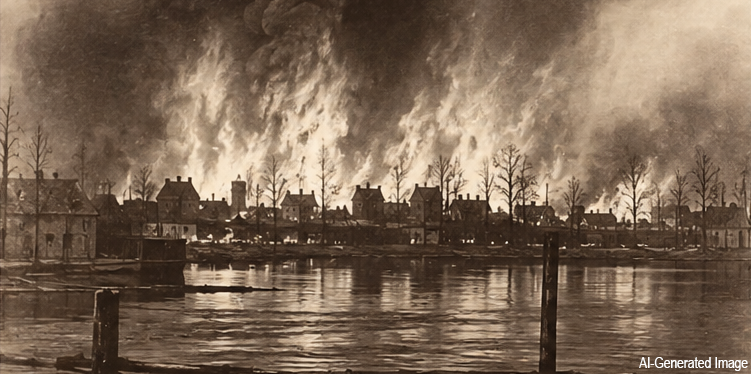
A smokey haze had descended upon Chicago in the late summer of 1871. As one ventured west from the Windy City, the visibility decreased to the point where the Green Island lightkeeper on Green Bay kept the lighthouse lamp lit for the entire month of September – day and night. The inhabitants of Northern Wisconsin and Michigan’s Upper Peninsula discussed a number of explanations for the daylight veil: farmers burning fields to remove stumps; lumberjacks engaged in aggressive slash-and-burn tactics; railroad construction crews clearing right of ways with fire; and sparks from coal-fired locomotives igniting dried tinder. Undoubtedly, a persistent and record-breaking drought over the past year exacerbated the situation.
Nestled in the center of northern Wisconsin’s vast hardwood forests, the bustling lumber town of Peshtigo was one of many communities benefiting from the voracious demand for wooden products by Chicagoans. Most of the town’s residents were employed at the world’s largest woodenware factory located in close proximity to the nation’s biggest sawmill. Wood was a way of life; boards for houses, chips for roads, saw dust in mattresses and ties for the ever-expanding reach of the railways – it was everywhere. By early October of 1871, that wood was bone dry.
As October 8th dawned, a massive low-pressure system moved eastward towards the Great Lakes bringing with it high winds from the southwest. By the end of the day, those winds had fanned multiple small fires into an epic 2000-degree firestorm. Peshtigo’s residents initially detected a “low rumbling noise, like the distant approach of a train.” In a matter of minutes that rumble became a thunderous roar accompanied by a 200-foot wall of fire that incinerated everything in its path.
A panicked populous fled to the nearby Peshtigo River dodging cattle fleeing in the same direction. Winds in excess of one hundred miles an hour blew people to the ground, burned lungs, and blinded hundreds. In a matter of hours, the town ceased to exist. Two hundred people died in a single tavern and three people who sought refuge in a water tank boiled to death when the fire heated the tank. When the inferno had abated, half of Peshtigo’s population had perished and not a single structure remained.
Texas ports throughout the summer were figuratively on fire. The movement of petrochemical and project cargoes dominated the trade landscape. On the brownwater front, the number of tows navigating across the Houston Ship Channel registered back-to-back highs in July and August. Overall, vessel arrivals from the high seas are up 8% for the state – eclipsing prior years by a wide margin.
As always, there are exceptions to the current trends. Brownsville, in particular, is trailing last year’s vessel count by 9% due to a marked decrease in both bulkers (down by 7%) and general cargo calls (18% fewer). On the other hand, the eastern “border” port – Sabine – is finishing out the summer with the highest year-over-year gains of all Texas ports. The 13% increase in vessel arrivals was bolstered by a 60% jump in LPG arrivals and 18% more tanker port calls. Tankers also posted their highest arrival count for the year in August. Bulkers followed suit with their highest arrival tally and are up 7% for year. Chemical tankers added heft to the summer, logging their best month in July; to date they are outpacing last year’s arrivals by 7%. In short, maritime trade is booming in East Texas.
The city of Corpus Christi may be in the midst of a water crisis but it certainly does not lack for waterborne trade. It, too, is ahead of 2025’s arrival stats by double digits – 10%. Like Sabine, BTU commerce has been dominating the waterfront. Tankers – the port’s most frequent constituent – may be up only 2% but its 2nd largest customer – chemical tankers – are up 25% for the year. LNG transits registered their two best months in July and August adding to its percentage gains over the last year – currently at 36%. Yet, the most impressive development for the year has been the 51% leap in bulker movements.
The Port of Galveston is also having a banner year as evidenced by the record number of cruise ships and tanker port calls. Both categories remain ahead of the prior year’s numbers by 8% and 10% respectively. Chemical tanker arrivals were particularly robust in August with their highest count for the year. Undoubtedly, the port’s recent expansion has been instrumental in attracting 15% more bulkers and 11% more RoRo vessels year-to-date.
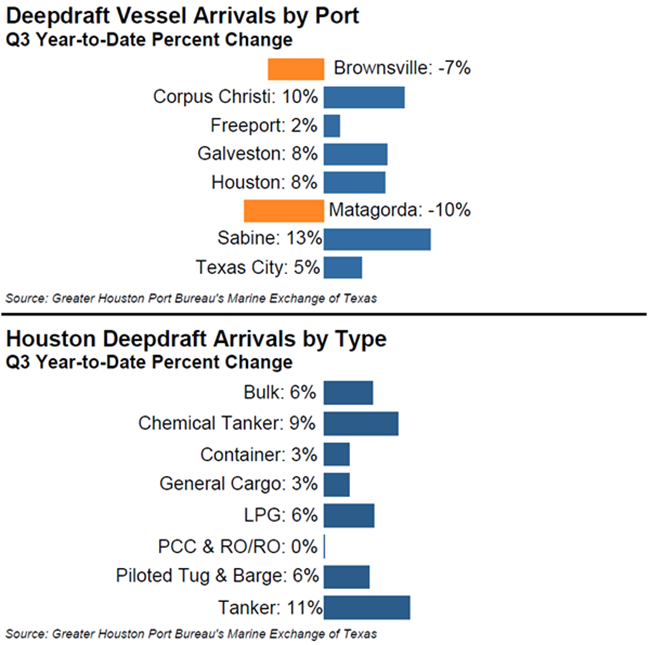 Freeport’s total vessel count continues to outpace Galveston by a dozen or two; however, its year-over-year gain is a mere uptick of 2%. Despite the BTU export binge that is dominating Texas ports, the majority of Freeport’s vessel categories are off for the year. Crude has been a major exception as evidenced by a substantial 62% gain in tanker arrivals. LPG has continued to post positive numbers for the year but chemical tankers – Freeport’s most popular vessel arrival – are lagging along with LNG.
Meanwhile, the Port of Texas City experienced a healthy summer bounce. August witnessed the highest arrival count in 2026 resulting in a 36% monthly ascent. Every vessel category saw positive percentage gains with chemical tankers and LPG vessels posting monthly highs. The dramatic gains for the summer pushed the port’s arrival count well into positive territory.
Texas’s trillion-dollar miracle – the Port of Houston – did not disappoint during the waning days of summer. Ordinarily, summer in the port is a respite before the fall flurry of traffic. Not so, this year. General cargo arrivals posted their two best months in July and August. Container vessels and integrated tows chalked up their highest arrivals in August as well. The nation’s largest export port lived up to its reputation with 8% more tanker calls, 10% more chemical tanker arrivals, and 6% more LPG vessel moorings as compared to 2025. Conversely, while a never abating TEU count continues to outpace prior tallies, export activity in this arena is waning. Nonetheless, containers, laden with imports, have shrugged that off as the demand for consumables by an ever-growing population persists.
The destruction of Peshtigo and dozens of other communities within the 1.2-million-acre swath of ashes received scant media attention despite the loss of over 2,000 people. That same evening, Chicago was aflame and over 17,000 wooden structures were destroyed leaving 100,000 homeless and 300 dead. Consequently, Chicago’s plight was plastered on newspapers from coast to coast. Yet, a persistent rumor of a miracle in the hamlet of Robinsonville, Wisconsin (modern day Champion, WI) was making its rounds on the eastern shore of Green Bay.
Upon the grounds at which the Queen of Heaven had appeared to a young Belgian immigrant - Adele Brice – stood a small chapel on 5 acres of donated land. The chapel was built by Adele’s father and bore the inscription “Our Lady of Good Help, Pray for Us.” The story of the Marian apparitions that took place on October 9, 1859, was well known and the faithful considered the site to be a sacred and holy place. When the fires raged throughout Door County 12 years later, it became a place of refuge for scores of families from the surrounding countryside.
Adele gathered the desperate families onto the Chapel grounds. She and the besieged refugees prayed numerous rosaries while they paraded a statue of the Blessed Virgin Mary around the grounds throughout the night. Despite the blistering heat and explosion of trees from relentless flames, the compound remained unsinged. After hours of prayers and hymns of praise to Jesus Christ, the fire subsided and rain fell when morning arrived. Remarkably, the entire compound was untouched by the firestorm but the exterior fence surrounding the Chapel grounds was badly charred. In fact, the only well that did not go dry from the fires was the Chapel’s shallow one.
Father Peter Pernin, pastor for the Catholic churches in Peshtigo, Marinette, and logging towns such as Robinsonville in Door County survived the destruction of Peshtigo by spending over 5 hours in the frigid Peshtigo River. In the aftermath of the fiery conflagration, he did what he could to tend to the needs of his flock. It was also imperative that he assessed the state of churches under his care. As he travelled to the various parishes he served, he observed that the great inferno had wiped Robinsonville from the map - save the modest Chapel built by Adele’s father. Father Pernin recounted, the sacred site was surrounded by utter desolation. Its survival defied all natural explanations. It was, “An Emerald Isle in a sea of ashes.”
About the Author

Tom Marian is the General Counsel of Buffalo Marine Service, Inc. He also serves on the Executive Committee of the Port Bureau Board of Directors.