
From Whales to Rail
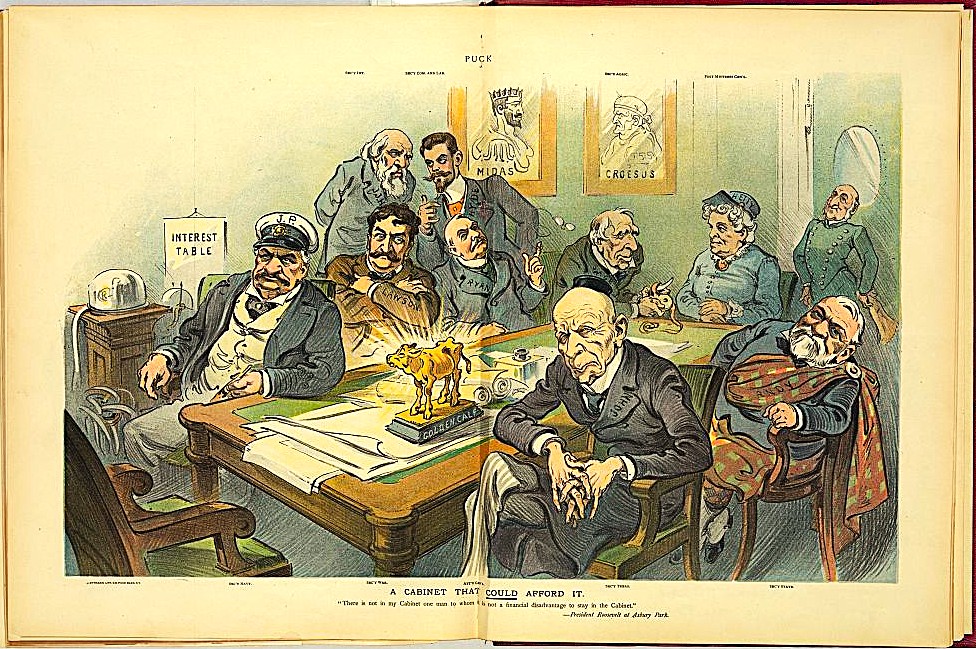 Hetty Green, Library of Congress image.
No one knew what to expect in Terrell, Texas, when the 24-year-old president of the Texas Midland Railroad Company – “Ned” Green – presented a $500,000 certified check for deposit. In January 1893, it was an unheard sum for the American National Bank, as evidenced by the fact that it immediately tripled the bank’s assets. Not surprisingly, Ned was immediately made vice president of the bank. Yet, Ned’s interest was not in banking. He was on a mission to transform the Texas Midland Railroad into a first-in-class railroad. To that end, heavy duty tracks were installed, wooden bridges replaced with steel, only the fastest of locomotives were purchased and Texas Midland’s passenger equipment was the most luxurious in Texas. Just as Ned spared no expense to make the railroad the finest in the region, he spent lavishly on personal vehicles, scientific pursuits and raucous entertainment.
Ironically, Ned’s propensity to spend was the antithesis of the individual that made his lifestyle possible. Hetty Green, Ned’s mother, was known as a ruthless businesswoman. Her draconian frugality combined with her extraordinary business acumen were instrumental in her accumulation of real estate assets, controlling interests in railroads and tens of millions of dollars in bank deposits. She viewed every transaction as a battle and her tenacity against the most ruthless of businessmen earned her the nickname of the “Witch of Wall Street.” While her father may not have been proud of his only daughter’s moniker, he certainly taught her well.
As a young girl, Hetty spent much of her free time in the shadow of her father Black Hawk Robinson. Black Hawk’s wealth resulted from his father-in-law’s New Bedford whaling business. While owning whaling ships in the 1830s was fraught with risks, Black Hawk’s firm prospered handsomely and put those profits to work in a variety of business ventures. As a young girl, Hetty would read the financial news to both her father and grandfather. It was not unusual for Hetty to accompany her father on various business ventures and witness his transactional shrewdness. As Hetty once recalled, “My father taught me never to owe anyone anything. Not even kindness.”
March was extremely kind to Texas ports as spring 2026 dawned. Every major port registered sizeable monthly gains. Corpus Christi, in particular, experienced a 31% jump in vessel arrivals. The dramatic year-over-year rise in bulker calls and chemical tanker arrivals placed the port at the top of the heap with an 11% year to date increase. LNG arrivals also soared 26% for the year. Unfortunately, the port’s most frequent caller – tankers – trails last year’s arrival count by 4% despite a torrid 55% monthly gain.
Meanwhile, tanker calls in Sabine far outpaced 2025’s first three months of the year by 25%. While its 12% year-to-date climb in bulker arrivals paled in comparison to Corpus’, LNG exports were off the charts as evidenced by a year-over-year ascent of 42%. Chemical tankers – the most frequent vessel type that calls upon Sabine – posted a monthly high and ended the quarter 5% above that of last year. Overall, Sabine’s vessel arrival count exceeds that of last year by a respectable 10%.
The Port of Galveston is also ahead of last year’s arrival pace by 5%. While 5% fewer passenger vessels moored at its public docks, 30% more tankers, 14% more chemical tankers, 44% more RO/RO vessels and double the number of bulkers cast their lines ashore over the last year. This is a marked contrast at the neighboring Port of Texas City. In spite of a healthy 23% monthly increase in arrivals, the port trails 2025’s stats by 16%. Its two largest vessel constituents – chemical tankers and oil tankers – are down for the year by 22% and 19% respectively. The only major vessel category that was not in the year-over-year deficit column was oceangoing barges. They are up by 8%.
Freeport’s final month of the year’s first quarter ended on a very positive note and placed the port on the right side of the ledger year-over-year. Chemical tankers finished particularly strong with an 88% climb; however, this vessel type lags 2025 by 7%. On the other hand, LNG, LPG and tankers exceeded last year’s arrival tally by 11%, 7% and 25% respectively. Undoubtedly, they were the main contributors to Freeport outshining last year’s first quarter by 2%.
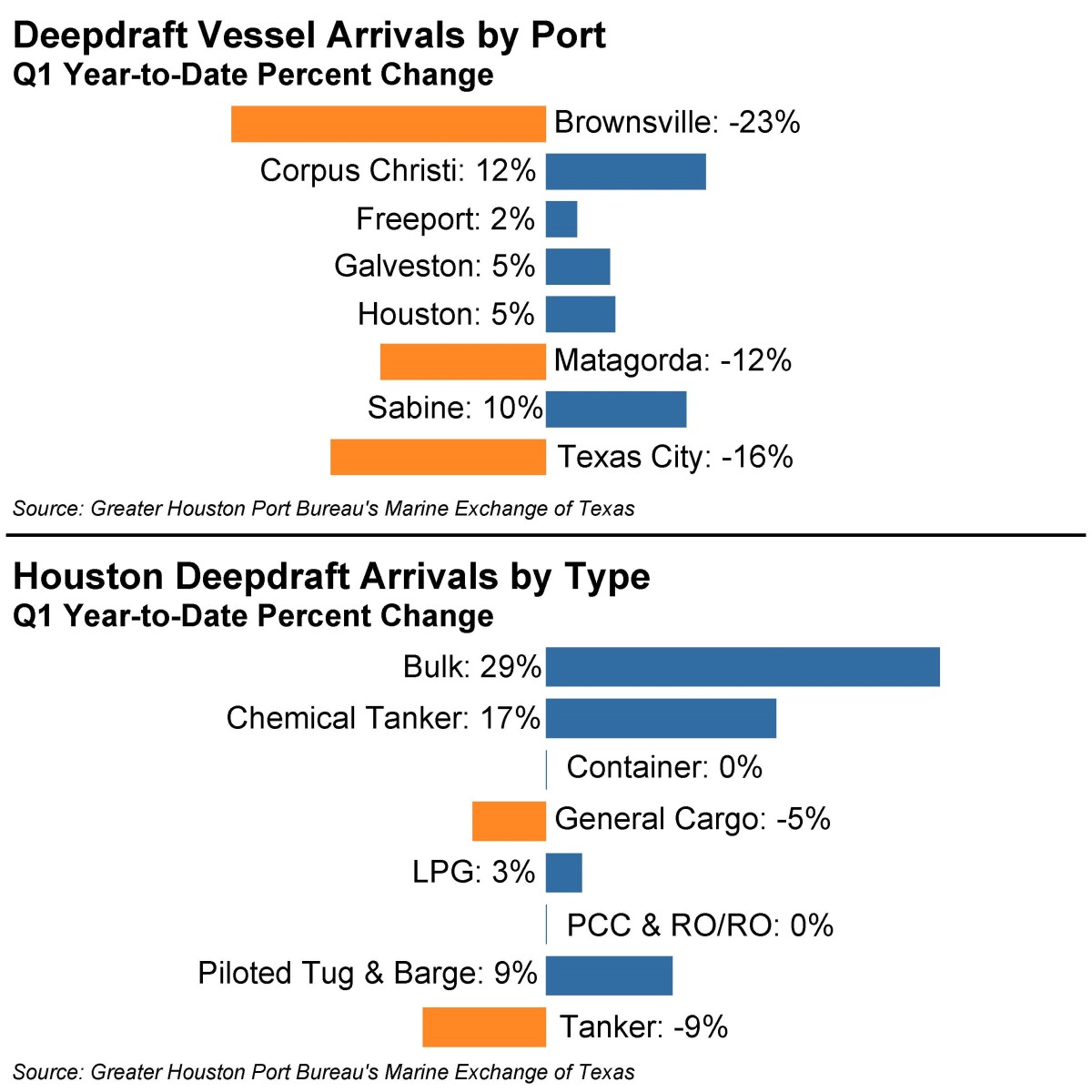 Texas’ most remote port – Brownsville – had very little to brag about with nearly every vessel category arrival count falling below last year’s number. At present, 2025’s vessel calls eclipse 2026’s by 23%; a result most likely driven by tariff uncertainty.
At the epicenter of all things maritime – Houston was certainly keeping many a terminal operator busy. Container traffic at the Gulf’s largest container port was flat in terms of arrivals. Nevertheless, 2% more TEUs flowed across the wharves. On the import front, the count for full TEUs was 4% higher vis-à-vis last year. On the export front, the year-to-date increase for full TEUs was a mere 1%. This is certainly a marker that both businesses and the local populace are expanding.
Chemical tankers ended the month extremely strong with a 35% rise. This bolstered the year-to-date increase to 17%. Bulker calls in Houston were at a record level in March and finished out the quarter 29% above that of last year. Conversely, tankers waned by 9% year-over-year irrespective of the 15% monthly gain. LPG transits held their own with a 3% year-to-date upswing. Finally, even taking into consideration a softening in the general cargo vessel count, the nation’s largest port’s arrival figures are a healthy 5% higher than 2025’s first quarter.
Hetty’s spartan existence was the antithesis of the financial empire she built during her lifetime. Her fiscal wherewithal was so abundant that she set market interest rates whenever she lent large sums of money to major institutions. When she passed on July 3, 1916, newspapers throughout the nation ran front page stories on the death of the richest woman in America whose estate was reported to between $100 and $200 million.
Hetty’s will divided her vast wealth between her two children, Ned and Sylvia. Unfortunately, there were several states that were covetously eyeing the potential inheritance and transfer tax bounty. Consequently, New Jersey, New York and Vermont attempted to claim Hetty as a resident. Ultimately, Hetty’s canny ability to move from apartment to apartment during her adult life served her well when the U.S. Supreme Court declared that she was a Vermont resident. Ultimately, when the legal sparring finally wrapped up, less than 2% of Hetty’s entire estate found its way into the taxman’s coffers.
Ned’s share of his mother’s estate was funneled into his Round Hill mansion which quickly became the epicenter for emerging scientific technologies. He constructed the most technologically advanced radio station in 1923; built one of the first illuminated runways in the nation to accommodate night landings replete with a blimp hanger; installed a prototype atom smasher for the benefit of MIT scientists; and erected large greenhouses to cultivate exotic plants from all over the globe. Ned also spent millions during the Great Depression on rare stamps, even rarer diamonds and buying all five 1913 Liberty “V-Nickels” - considered to be the most valuable coins ever minted in the United States.
Undoubtedly, Hetty would have frowned at her son’s profligate spending. Worse yet, she would have gnashed her teeth knowing that the vast fiscal kingdom she had built would be cast to the wind upon the death of her daughter 14 years after her brother’s funeral. As neither Ned nor Syliva had heirs, Ned’s estate flowed to Sylvia and, in turn, Sylvia left tens of millions of dollars to numerous causes.
On the other hand, there was one purchase on the part of Ned that would have elicited approval from his curmudgeon mother. Several years before his death, Ned discovered that a storied whaling ship owned by his great grandfather was slated for the boneyard. He purchased that sailing vessel, fastidiously restored it and permitted tens of thousands of tourists to board it at Round Hill’s waterfront. Today, the Charles W. Morgan – a waterborne asset that gave rise to the family fortune - is moored at Mystic Seaport where countless visitors gaze upon a vessel that played a crucial role in America’s first oil boom.
About the Author
Tom Marian is the General Counsel of Buffalo Marine Service, Inc. He also serves on the Executive Committee of the Port Bureau Board of Directors.