
Defending America's Skies: Security Council Leader's Urgent Call at AFPM Security Conference
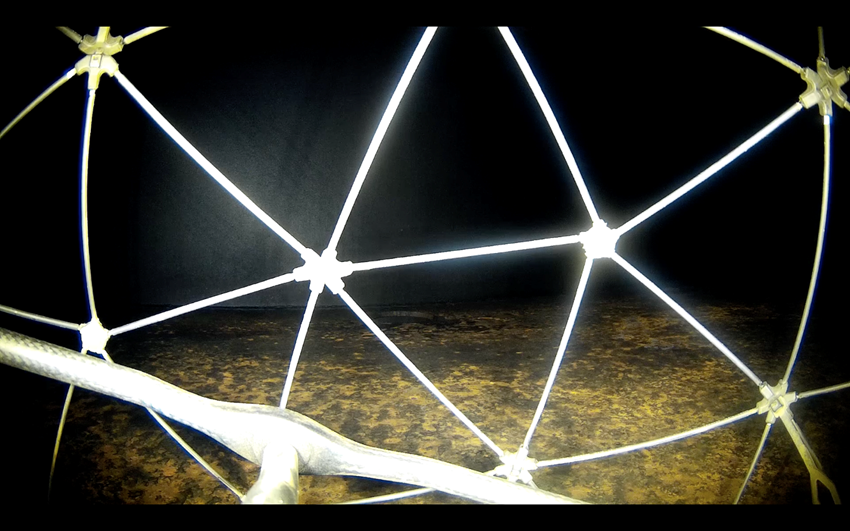 Birdseye view from a drone inspection.
In a crisp and forceful address at the American Fuel & Petrochemical Manufacturers ("AFPM") Security Conference in New Orleans, Dr. Sebastian Gorka, Deputy Assistant to the President and Senior Director for Counterterrorism at the National Security Council, delivered a sobering message to the men and women who power American civilization: the drone threat to critical energy infrastructure is no longer theoretical — it is here, it is real, and it demands immediate action.
Gorka opened by noting a striking shift. For roughly six years prior, Washington largely slept on the issue, with policies and agencies often unwilling or unable to confront the problem head-on. That changed instantly under President Trump. The very first National Security Council meeting of the new administration tackled drones directly — a clear signal of the priority the President places on protecting the homeland.
Drawing from hard lessons overseas, Gorka painted a vivid picture. Low-cost commercial drones — some no more sophisticated than toys once bought for a child’s Christmas — have repeatedly struck oil facilities in the Middle East and refineries in Eastern Europe, disrupting global energy markets and logistics with alarming ease. These are not always precision strikes by nation-states. Criminals, terrorists, and even reckless “idiots and evildoers” can now wield modified off-the-shelf systems to inflict massive damage. The logic is brutally straightforward: to cripple a nation, target what sustains it. For America, that means refining capacity, distribution nodes, and storage facilities.
This administration’s response rests on restoring a core principle: American airspace belongs to the American people, and the United States will defend it with zero ambiguity and no gray zones. The Executive Order on Restoring American Airspace Sovereignty, issued in June 2025 and advanced with NSC coordination, created the Presidential Task Force to Restore American Airspace Sovereignty. Gorka, who helps lead the task force with monthly interagency coordination, emphasized that every aircraft — manned or unmanned — operating over U.S. territory is subject to American law and accountability.
In just over a year, measurable progress has followed at a pace Gorka insightfully calls “Trump time” — rapid, decisive, and hard to keep up with.
Key Accomplishments to Date
- The SAFER SKIES Act (enacted December 2025), which empowers state, local, tribal, and territorial law enforcement with expanded counter-UAS authorities so responders can act when a drone hovers over a refinery — without waiting for distant Washington approval.
- The FBI’s new National Counter-UAS Training Facility at Redstone Arsenal, which has already graduated its first classes in record time, producing skilled operators who neutralize threats safely, legally, and effectively.
- Historic funding — $500 million through the DHS/FEMA Counter-UAS Grant Program, with the initial $250 million rollout described as among the fastest non-disaster awards in recent memory — to equip states with detection, tracking, and mitigation tools.
- Early operational deployments of high-energy directed lasers for counter-UAS inside the United States.
- Close partnership with the Department of Defense and interagency task forces that stress speed: “Detection without decision is delay. Decision without action is failure.”
These layered protections extend to major national events, including America’s 250th anniversary and the FIFA World Cup, while keeping critical infrastructure front and center.
Yet Gorka was candid: policies alone will not suffice. Real defense requires partnership and industry leadership. He issued clear “homework” for the energy sector:
- Engage vigorously in upcoming FAA rulemaking — particularly expansions under Section 2209 for critical infrastructure, beyond-visual-line-of-sight (BVLOS) operations, and unmanned traffic management. Industry comments matter; make your voice heard.
- Support legislation to expand counter-UAS authorities directly to private critical infrastructure owners and operators. The administration backs this because energy professionals are frontline defenders of national resilience, not passive stakeholders.
- Invest now in detection, tracking, identification, and physical hardening using proven technologies already available.
Tell your stories. Document drone incursions, share data through established channels to build heat maps and drive policy, and speak publicly — through op-eds, association reports, or industry statements — about the real challenges and the progress being made. As Gorka reminded the audience, humans understand the world through stories; effective narratives accelerate solutions and break bureaucratic inertia.
Timely Progress on FAA Rulemaking
Having the opportunity to hear Dr. Sebastian Gorka and Matthew Whitehead of the National Security Council deliver timely and direct remarks on the evolving drone threats targeting energy and petrochemical facilities, their message was clear: these risks are real, and the industry must stay ahead of them.
April 24th brought welcome news on that front. OMB/OIRA has cleared the FAA’s long-awaited NPRM — “Designation - Restrict the Operation of an Unmanned Aircraft in Close Proximity to a Fixed Site Facility” (RIN 2120-AL33). Link:(https://www.reginfo.gov/public/do/eoDetails?rrid=947211)
Submitted to OIRA in May 2025 and cleared on April 24, 2026, this rulemaking implements Section 2209 of the 2016 FAA Extension Act. It establishes a formal petition process enabling owners and operators of refineries, chemical plants, and other critical fixed-site facilities to request restricted UAS airspace for safety and security reasons.
The NPRM is expected to be published in the Federal Register in the coming days or weeks, opening a public comment period. This represents a meaningful step forward in giving industry the tools needed to better protect vital infrastructure.
Dr. Gorka’s three decades in counterterrorism, multiple oaths to the Constitution, and service across two Trump administrations bring evident patriotism and seriousness to the mission. He and his team — including Matt Whitehead and interagency partners — treat this as a zero-failure mission, whether safeguarding the White House, Marine One, public events, or the refineries and pipelines that sustain daily American life.
While political critics may differ with Dr. Gorka on style or broader views, his emphasis on practical sovereignty, rapid results, and empowering those closest to the threat reflects a clear commitment to America First priorities. The energy sector’s active participation — through advocacy, investment, and honest storytelling — will help accelerate the emerging doctrine of responsible action over hesitation.
America will not surrender its skies. With urgency, partnership, and vigilance, the nation can confront this evolving threat decisively and keep the lifeblood of its economy and civilization secure.
About the Author

Marco Ayala
InfraGard National Sector Chief-Energy
International Society of Automation Fellow
infragard-houston.com