
From Chaos to Clarity: Digitizing Pre-Arrival Communications to Improve Port Efficiency
Houston’s maritime industry has long understood the strategic importance of the Houston Ship Channel. It is a critical gateway for the region, the state of Texas, and the nation, supporting a broad network of businesses that depend on safe, reliable, and efficient vessel operations. While the Port of Houston is an amazing place, industry benchmarking shows that it can lag behind other international liquid hub ports like Rotterdam and Singapore in terms of tanker turnaround time.
Turnaround time is a key metric when it comes to measuring port efficiency because it includes waiting time, cargo operations, and sailing time. Lower port turnaround times mean that vessels are moving through the port more efficiently. The related impacts include better carrier schedule reliability, increased terminal throughput, reduced demurrage for charterers, and better return on port infrastructure. Efficiency is not simply an operational preference; it is a competitive advantage and a force multiplier for future growth.
One promising lever to reduce port turnaround time is the digitization of pre-arrival communications. Pre-arrival refers to the exchange of key information among the terminal, carrier, agent, and surveyor before a vessel reaches the berth— ideally far enough in advance for questions to be resolved before operations begin. This information may include cargo names and quantities, equipment requirements, physical arrangements, and terminal services such as garbage removal, MARPOL, fresh water, or transshipment needs.
Today, many tanker pre-arrivals in Houston are still mostly managed through manual emails, phone calls, and company specific spreadsheets/forms. Each terminal and carrier may use its own process, making every call a customized exercise. Long email chains can obscure the latest information, widen distribution beyond what is needed, and create unnecessary risk around sensitive commercial data. In this environment, situational awareness often requires piecing together details from multiple changing sources.
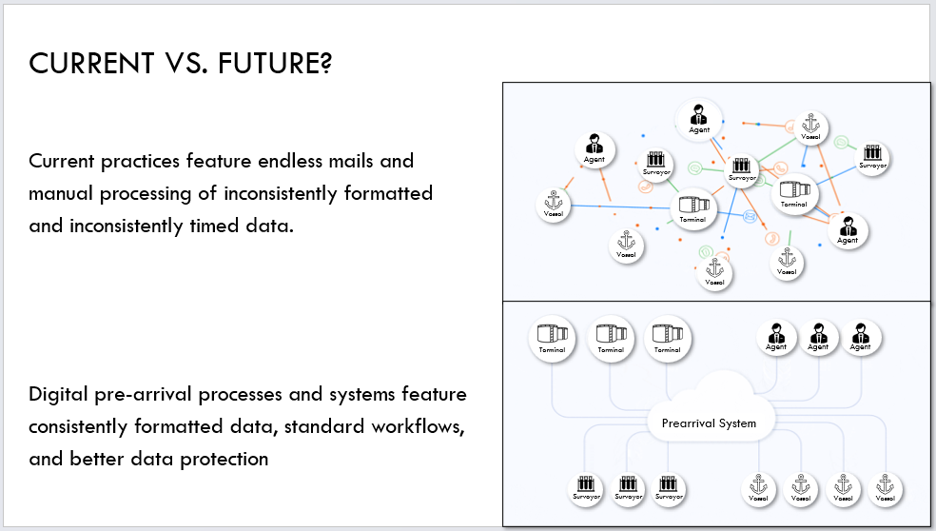
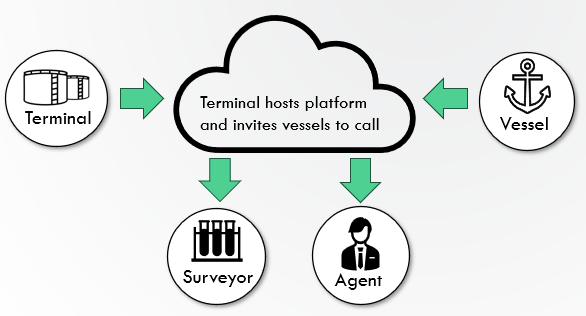
Digital pre-arrival platforms offer a more disciplined model. There are various pre-arrival digitization vendors in the market, and they all have their own operating models. That said, it is most common for these systems to be set up whereby the terminal pays the cost and hosting the platform. The terminal then uses the digital platform to invite calling vessels to provide pre-arrival information within a defined timeframe.
While carriers and terminals are the main information providers to the platform, commercially relevant partners such as agents, surveyors, and charterers can be granted access to the platform to view the latest information. Commercially sensitive information is protected while emails and phone calls are minimized for exceptional situations.
 While there is a cost to the terminal, the business case is usually compelling. Depending on the terminal and operation, digital pre-arrival processes appear to consistently save between 30 minutes to 1.5 hours alongside per vessel call. Across a year, those savings can translate into meaningful additional capacity, improved berth productivity, lower waiting time, and reduced overall port turnaround time. Importantly, this is not experimental technology. Similar tools are already used in Europe and Asia with positive results, and vendors with proven solutions are now engaging the Houston market.
A key challenge, however, is interoperability. Houston’s maritime community is diverse, and companies have already invested in the internal systems that work best for their operations. Digitization should not require every stakeholder to abandon those systems. Instead, the goal should be to make it easier for existing systems to connect securely and consistently with pre-arrival platforms.
To support that objective, the Greater Houston Port Bureau Efficiency Committee developed a back-end pre-arrival data standard. The committee reviewed vessel and terminal pre-arrival forms across oils, gases, and chemicals, identified common data fields, and organized them using consistent naming conventions, definitions, and structure. The resulting standard includes more than 300 data fields and is intended to reduce repeated mapping work as multiple platforms enter the market.
With a common data standard, automation built for one platform can be more readily adapted to others. That gives terminals, carriers, agents, surveyors, and technology providers room to innovate while still working from a shared foundation. In practical terms, it allows Houston to preserve flexibility while accelerating adoption.
The data standard also fits into a broader port digitization model that is especially relevant for Houston because there is not currently a single central system governing all port call information. Instead, Houston can evolve as a connected ecosystem.
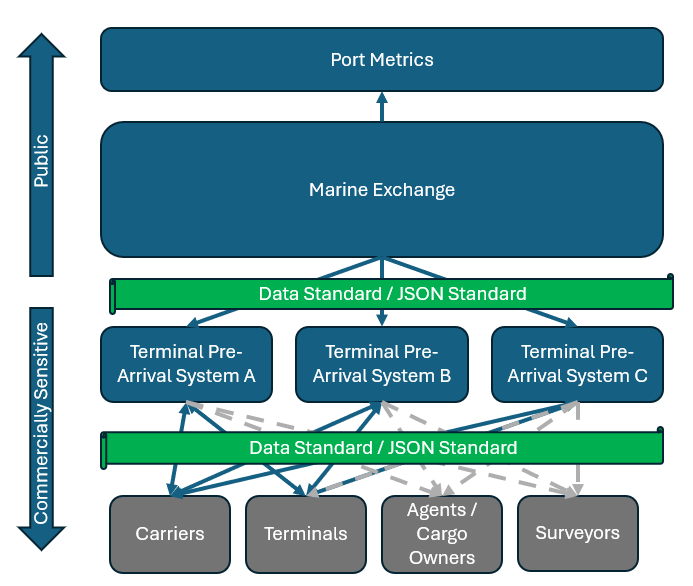 In the adjacent figure, at the top of the ecosystem is a port metrics layer: a public-facing tool that can summarize high-level port performance, support regional marketing, and benchmark Houston against other leading ports. This layer is key to establishing a common foundational understanding of port efficiency in Houston… and that it is likely that it will exist in the near future. The Greater Houston Port Bureau has already advanced this concept by compiling an RFP for a port metrics KPI vendor and is currently working through the vendor selection process.
Beneath that public metrics layer is a Marine Exchange function. This layer would not replace commercial systems or private platforms. Rather, it would provide a trusted operational information exchange for the port community. Houston’s existing PilotTracker system can be viewed as an example of this middle layer because it already provides useful information tied to vessel movement and pilotage. Over time, a broader Marine Exchange concept could potentially connect and compile additional operational inputs from government agencies such as, but not limited to Vessel Traffic Services, U.S. Customs, U.S. Coast Guard.
The next layer is where private-sector pre-arrival service providers operate. These platforms are already moving into the Houston market and can help terminals manage commercially sensitive operational information in a secure, structured way. This distinction is important. Not every piece of port call information should be public, and not every stakeholder needs access to every data point. A sound digitization strategy should separate what belongs in public port performance reporting from what belongs in trusted operational exchange and what must remain in permissioned commercial workflows.
This layered approach does not require one mandated platform, nor does it force companies to abandon their existing internal systems. Instead, it creates a common language for port call data. Carriers, agents, cargo owners, terminals, surveyors, and technology vendors can each continue to operate their own systems while using consistent definitions, naming conventions, and data structures when information needs to move between systems.
This is particularly valuable in a market like Houston, where scale and diversity are strengths but also create integration complexity. If each digital platform uses a different structure, every new connection requires new mapping, testing, and maintenance. If platforms align to a common data standard, the industry can reduce duplicate integration work and make automation more scalable. That means a terminal using one pre-arrival system, a carrier using another internal system, and a surveyor relying on still another workflow can exchange information more efficiently because the underlying data is organized consistently.
The practical result is a digitization path that respects Houston’s decentralized operating reality. Rather than waiting for a single comprehensive system to emerge, the port community can digitize in layers: public metrics to demonstrate performance, a Marine Exchange layer to improve shared operational awareness, private pre-arrival platforms to manage commercially sensitive workflows, and a common data standard to connect them. This layered approach allows innovation and competition among vendors while still moving the region toward a more coordinated digital future.
Houston’s maritime community has a clear opportunity: move pre-arrival communication from fragmented manual exchange to structured, secure, digital collaboration. By doing so, the port region can reduce time alongside, improve throughput, protect sensitive information, and remain competitive with other leading global port regions. The technology is available, the value case is strong, and the data foundation is in place. The next step is adoption.
Read more articles from the Port Bureau's efficiency committee by clicking here. The Efficiency Committee seeks to work together to shape efficiency and digitalization in the Houston port region. For more information, e-mail info@txgulf.org.

Lance Nunez
Dow Inc.
dow.com