
Port Region Advances in Infrastructure Investment, Efficiency in 2025
2025 was full of challenges but the Houston port region continued to demonstrate its strength, resilience, and growing national significance across commercial, energy, and passenger maritime sectors. The ports of Houston, Galveston, Texas City and Freeport played a critical role in supporting global trade, energy security, and regional economic growth. While cargo volumes experienced a modest decline, overall activity remained strong. We were able to advance our infrastructure investments, and the collaboration among port partners continued to enhance safety and operational efficiency across the Houston Ship Channel and surrounding waterways.
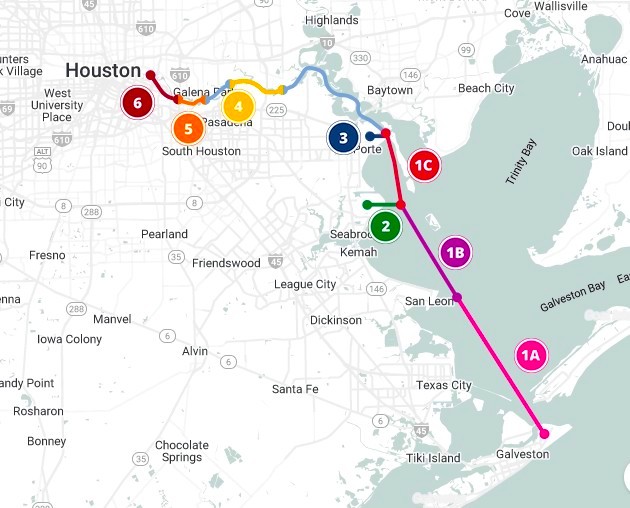 The completion of Project 11 on the Houston Ship Channel marked a significant milestone for the port region, delivering meaningful improvements to navigation safety and operational efficiency. As a direct result of the channel widening, from 530 ft to 700 ft, the pilots are now able to move most vessels without daylight restrictions, allowing for greater flexibility in scheduling and improved vessel throughput. These enhancements reduce transit delays, support safer two-way traffic, and strengthen the channel’s capacity to accommodate larger and more frequent vessel movements, reinforcing the Houston Ship Channel’s role as a critical gateway for commerce and energy exports.
We also witnessed a major highlight in 2025 with the continued expansion of the cruise industry as the Port of Galveston once again delivered a record-setting year for cruise activity. They welcomed well over 1.78 million passengers, solidifying its position as one of the fastest-growing cruise homeports in the United States. Cruise operations generated significant economic impact for the region while supporting thousands of local jobs.
In 2025, the Port of Texas City reached an important milestone in its role as a critical energy hub, continuing to support strong volumes of crude oil and refined petroleum products moving through the region. The port’s strategic location and infrastructure allowed it to play a key role in supporting refinery operations, energy exports, and supply chain reliability along the Upper Texas Coast. These activities reinforced Texas City’s longstanding importance to the nation’s energy sector while contributing to regional economic stability and maritime traffic efficiency.
As we reflect on 2025, I am proud to share that it was a year marked by meaningful progress, strong collaboration, and impactful advocacy for the Greater Houston Port Bureau and our port community. One of our most significant accomplishments was the successful passage of House Bill 2970, a critical legislative effort aimed at enhancing two-way vessel traffic safety and operational efficiency within the Houston Ship Channel. This achievement would not have been possible without the dedication of our Advocacy Committee, the support of our members, and the collaboration of our state leadership. HB 2970 represents a major step forward in improving navigational safety while supporting the continued growth and economic vitality of our ports.
In addition, our Dredging committee was key in working with the Army Corps of Engineer (“ACOE”) for an improvement to the process for approving dredge material placement area (“DMPA”) permits for our waterfront facilities. We had several meetings with senior ACOE leaders, to request a delegation of authority to the Galveston District for DMPA. By delegating authority from the Division level to District level, we estimate that facilities will save 4-6 weeks of the permitting process. As a result, project timelines will be shortened, operational disruptions minimized, and greater predictability achieved for private facility dredging activities. This improvement enhances efficiency across the port region, supports timely maintenance and expansion projects, and reflects the value of proactive collaboration between industry stakeholders and the Army Corps of Engineers in advancing safe and reliable maritime operations.
Beyond advocacy and dredging, 2025 was a year of strengthened engagement and connectivity. Through our Commerce Club luncheons, Maritime Dinner, committee meetings, and industry events, such as our Port 101, Port Bureau Connect and Women in Maritime, we continue to bring together over 5,000 maritime professionals, public officials, and stakeholders to foster dialogue and build relationships that advance our shared mission. Our social media footprint and Port Bureau News magazine continued to gain traction in 2025, generating more than 50,000 views and significantly expanding our reach and engagement across the port and maritime community. With the help of all of you, we’ll continue to be the voice of the port region!
As we look ahead to 2026, we remain focused on promoting safe, efficient, and sustainable port operations while expanding opportunities for member engagement and industry leadership. We know advocacy and collaboration will remain key to sustaining this momentum. Thank you to our port partners, industry stakeholders, and public leaders for their continued support and commitment to keeping our waterways safe, efficient, and globally competitive. Let’s continue to promote our ports and advocate for the infrastructure and policies that support long-term success. #myportcommunityisbetterthanyours
About the Author

CAPT Eric Carrero, USCG (Ret.), joined the Greater Houston Port Bureau as president on July 1, 2023. He has 26 years of service in the U.S. Coast Guard, with experience in international affairs, port and vessel operations, and serving in the Sector Houston-Galveston from 2013-2021. CAPT Carrero holds a bachelor’s degree in biology from the University of Puerto Rico and a master’s degree in environmental management and policy from the American Public University System.